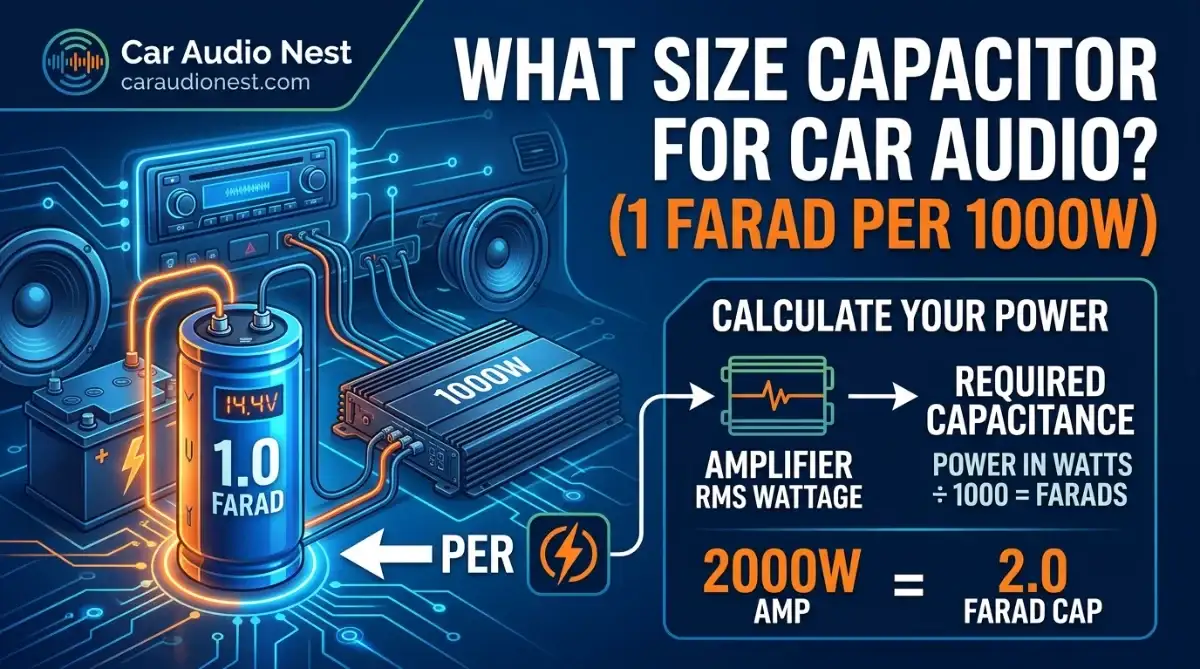
If your headlights dim when the bass hits, a capacitor is often the first fix people reach for. Sizing one is simple, but it helps to know what a capacitor can and can’t do before you buy, because it isn’t extra power, just a short-term buffer.
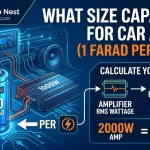
Quick answer: Use the common rule of 1 farad per 1,000 watts RMS of total amplifier power. A 1,500 W RMS system needs about 1.5 farads (round up to 2 F). Going larger is fine. Going smaller gives less benefit.
Capacitor Size Chart
| Total amplifier power (RMS) | Recommended capacitor |
|---|---|
| Up to 500 W | Usually not needed; 0.5–1 F if you have voltage dips |
| 500–1,000 W | 1 F |
| 1,000–1,500 W | 1.5–2 F |
| 1,500–2,000 W | 2 F |
| 2,000–3,000 W | 3 F, plus the Big 3 upgrade |
| 3,000 W and up | Electrical upgrades first (alternator, battery); a capacitor alone won’t keep up |
Add up the RMS ratings of every amplifier in the system, not peak or “max” figures. If you’re still choosing the amp, start with what size amp you need for your sub.
What a Capacitor Actually Does
A car audio capacitor stores a small amount of energy and releases it very quickly when a bass note causes a sudden current spike. That helps keep the voltage at the amplifier steadier during brief peaks, which can reduce mild headlight dimming and help the amp stay clean on transients.
What it does not do is create power. If your alternator and battery can’t supply the system’s average demand, the capacitor drains and recharges from the same weak supply. For the full background, see our car audio capacitor guide.
Capacitor vs Big 3 vs Second Battery
| Upgrade | What it fixes | Best for |
|---|---|---|
| Capacitor | Short voltage dips on bass hits | About 500–2,000 W RMS systems with mild dimming |
| Big 3 wiring upgrade | Voltage lost through undersized factory charging and ground cables | Any system over about 1,000 W RMS; often the best first step |
| AGM / second battery | Sustained demand and listening with the engine off | Larger systems and long sessions |
| High-output alternator | Total charging capacity | Big systems (roughly 2,500 W RMS and up) |
How to Install a Capacitor Safely
- Disconnect the battery’s negative terminal before you start.
- Mount the capacitor close to the amplifier, on the power wire between the main fuse and the amp. Follow the manufacturer’s maximum distance.
- Charge it before connecting it. Use the charging resistor or test bulb supplied with the cap. Connecting an empty capacitor directly causes a large spark and can blow fuses or damage the cap.
- Connect power and ground with the same gauge wire as your amp, and ground to bare chassis metal near the amp.
- Reconnect the battery and check the cap’s display (if fitted) reads close to battery voltage.
A charged capacitor holds energy even after the car is off. Discharge it through the resistor or bulb before removing it.
Signs You Need More Than a Capacitor
- Headlights dim heavily even with a correctly sized capacitor installed.
- Voltage at the amp drops below about 12 V while playing with the engine running.
- The amp goes into protect mode on long bass passages.
- Your battery struggles to start the car after listening sessions.
Those point to charging capacity, wiring or battery limits. Do the Big 3, check your power and ground wire gauge, and consider an AGM battery. Then re-check your amplifier settings: our guide to LPF on an amplifier helps you avoid sending unnecessary power to the sub.
Frequently Asked Questions
Can a capacitor be too big for car audio?
Not in a harmful way. A larger capacitor than the 1 farad per 1,000 W rule suggests won’t damage anything. It just costs more and takes longer to charge during installation.
Do I need a capacitor for a 1000 watt amp?
Only if you see voltage dips such as dimming lights. If you do, a 1 F capacitor is the usual size. Check whether the 1,000 W figure is RMS or peak: many amps advertised at 1,000 W peak make far less RMS and may not need one.
Will a capacitor drain my battery?
A healthy capacitor draws negligible current once charged, though models with a digital voltage display add a small draw. Some disconnect with the remote turn-on lead. Check the manual if your car sits for long periods.
Is a capacitor better than a second battery?
They solve different problems. A capacitor handles very short peaks, while a second battery supplies sustained current. For big systems or engine-off listening, a battery is the better upgrade.