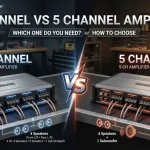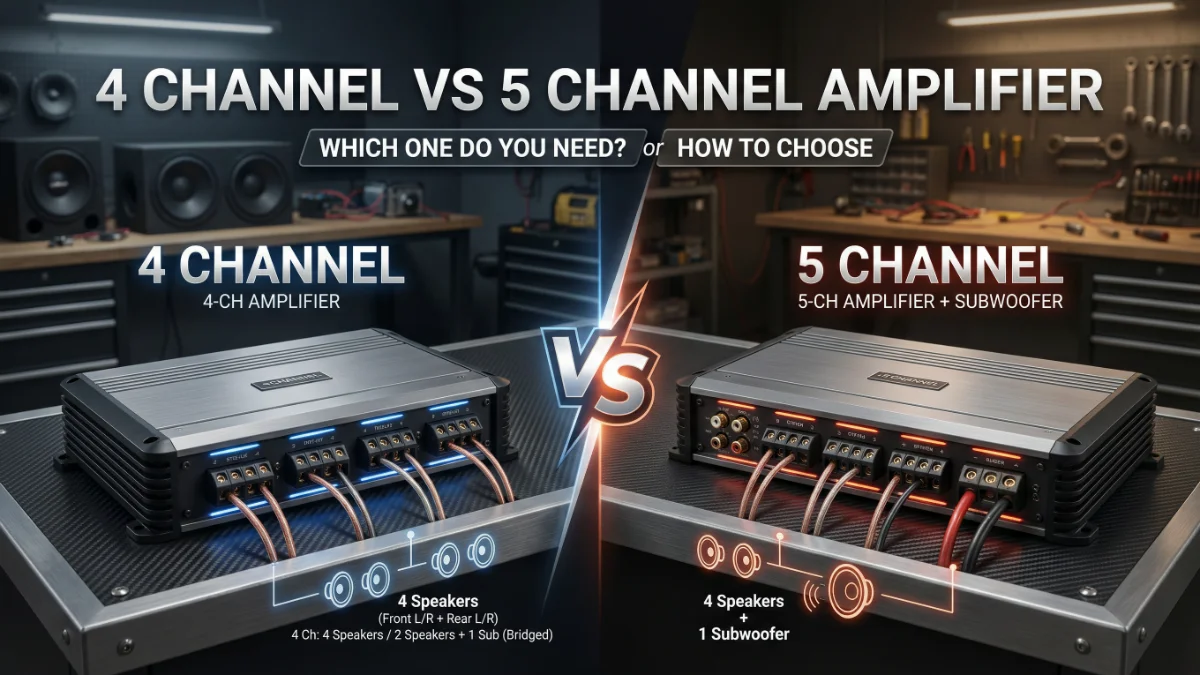
A 4-channel amplifier powers four speakers. A 5-channel amplifier powers those same four speakers plus a subwoofer from one chassis. That single extra channel changes the wiring, the cost and how much space you need. Here’s how to pick the right one for your system.
Disclosure: Car Audio Nest is reader-supported. We may earn a commission when you buy through links on this page, at no extra cost to you. Learn more.
Quick answer: Choose a 4-channel amp if you’re only powering door speakers, or if you want a separate, more powerful mono amp for a big subwoofer. Choose a 5-channel amp if you want one compact amplifier to run four speakers and a single subwoofer with simpler wiring.
4 Channel vs 5 Channel at a Glance
| Factor | 4-channel amp | 5-channel amp |
|---|---|---|
| Channels | 4 full-range channels | 4 full-range + 1 mono subwoofer channel |
| Powers | Front and rear speakers (or front components + a bridged sub) | Four speakers and one subwoofer |
| Subwoofer power | Only by bridging two channels (usually modest) | Dedicated sub channel, typically a few hundred watts RMS |
| Wiring | One amp, or two amps if you add a mono sub amp | One power, ground and remote wire for the whole system |
| Space | Compact, but two amps take more room | One chassis, ideal for small vehicles |
| Best for | Speaker-only upgrades, or high-power sub systems with a separate mono amp | Complete moderate systems in one box |
When a 4 Channel Amp Makes Sense
- You’re upgrading speakers only. Four channels for front and rear door speakers (or front components) is the classic setup.
- You want serious bass. A dedicated mono amp for the subwoofer usually delivers far more clean power than any 5-channel amp’s sub channel.
- You want flexibility. Many 4-channel amps can run front speakers on two channels and bridge the other two for a small sub.
When a 5 Channel Amp Makes Sense
- You want a complete system in one amp. One set of power, ground and remote wires, one fuse and one mounting spot.
- Space is tight. Compact 5-channel class-D amps fit under seats in cars and trucks.
- Your sub needs moderate power. A single 10″ or 12″ rated around 300–500 W RMS is the sweet spot for most 5-channel sub outputs.
How to Size the Power
For door speakers, look for roughly 50–100 W RMS per channel at 4 Ω for most aftermarket coaxial and component sets. For the subwoofer channel, match the sub’s RMS rating at its final impedance. Our guide on what size amp you need for your sub walks through it step by step. If the sub needs much more power than the 5-channel amp’s sub output provides, go with a 4-channel plus a separate mono amp.
Wiring Tips for Either Setup
- Use the power and ground wire gauge the manual specifies for the amp’s fuse rating.
- Set high-pass filters on the speaker channels (around 80 Hz to start) and the low-pass on the sub channel (see what LPF means on an amplifier).
- If your head unit has no preamp outputs, choose an amp with speaker-level (high-level) inputs.
- Above roughly 1,000 W RMS total, consider the Big 3 upgrade, and see what size capacitor you need.
Where to Start Shopping
Browse 5-channel car amplifiers or 4-channel car amplifiers from established brands such as JL Audio, Rockford Fosgate, Kicker, Alpine and Kenwood, and compare RMS ratings at 4 Ω rather than peak power. For our tested picks, see best car amplifiers.
Frequently Asked Questions
Is a 5 channel amp better than a 4 channel?
Not better, just different. A 5-channel amp is more convenient for a complete system in one box, while a 4-channel amp plus a separate mono amp usually gives the subwoofer more power.
Can a 4 channel amp power a subwoofer?
Yes, if it supports bridging. Two channels bridged together can power a subwoofer, but check the minimum bridged impedance (often 4 Ω) and expect less power than a dedicated mono amp.
Can I run only 4 speakers on a 5 channel amp?
Yes. You can leave the sub channel unused and add a subwoofer later. That’s a common way to build a system in stages.
Do I need a capacitor for a 5 channel amp?
Usually not for moderate systems. If your lights dim on bass hits, follow the 1 farad per 1,000 W RMS rule, and check your wiring and battery first.