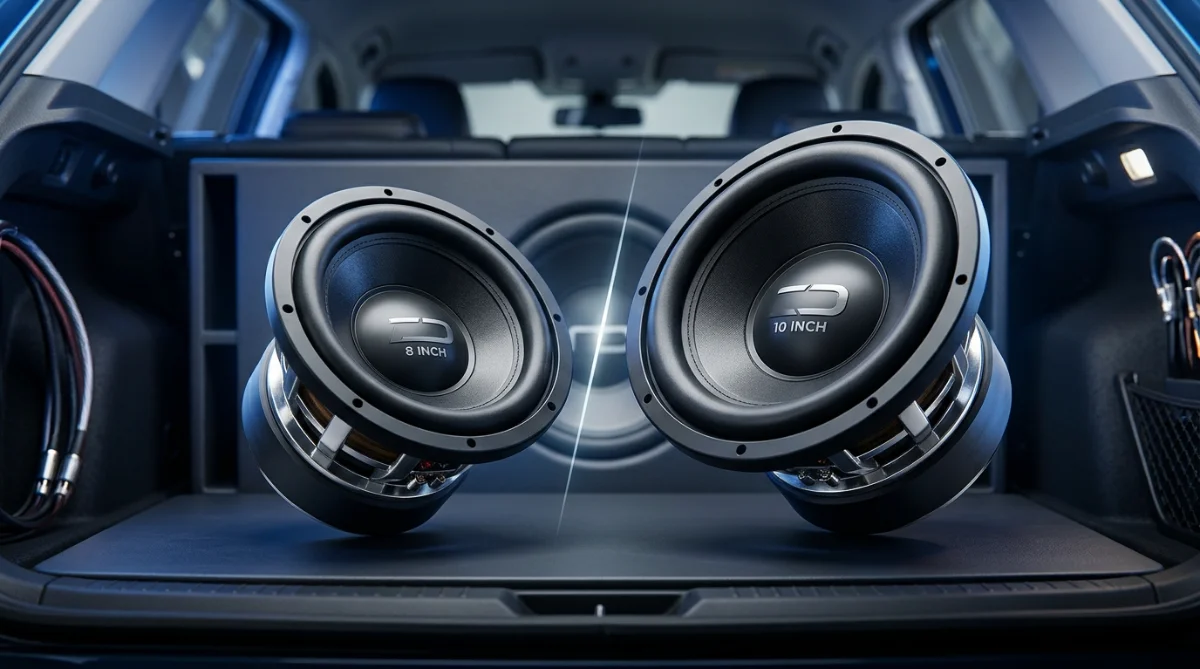
Choosing between an 8 inch and a 10 inch subwoofer comes down to three things: how much space you have, how deep you want the bass to go, and how much amplifier power you can give it. Both sizes are popular for daily drivers. They just do slightly different jobs.
Quick answer: For most cars, a 10 inch subwoofer is the better all-rounder. It has roughly 50–60% more cone area than an 8 inch, so it plays deeper and louder. Pick an 8 inch when space is tight (under a seat, in a small trunk) or when you want quick, punchy bass from a small amplifier.
8 Inch vs 10 Inch Subwoofer at a Glance
| Factor | 8 inch subwoofer | 10 inch subwoofer |
|---|---|---|
| Effective cone area (typical) | About 200–230 cm² | About 320–350 cm² (roughly 50–60% more) |
| Bass character | Tight, fast, punchy | Deeper, fuller, more output |
| Typical sealed box volume | About 0.3–0.5 cu ft | About 0.5–1.0 cu ft |
| Typical power handling (RMS) | About 150–300 W | About 200–500 W |
| Best locations | Under-seat, behind the seat, small trunks | Trunk, hatch, behind truck seats |
| Best for | Rock, metal, pop, sound quality on a budget | Hip-hop, EDM, all-round daily systems |
Ranges are typical for mainstream car subwoofers. Always check your specific driver’s spec sheet for recommended box volume and RMS power.
Why Cone Area Matters So Much
Bass output depends on how much air a subwoofer can move. That is cone area multiplied by how far the cone travels (excursion). A 10 inch sub doesn’t just look a little bigger: its cone area is roughly half again larger than an 8 inch. At the same excursion it moves far more air, which is why it reaches lower notes at a usable volume without straining.
An 8 inch sub can still sound excellent. A smaller, lighter cone starts and stops quickly, so kick drums and fast bass lines sound tight and controlled. What it can’t do is move as much air below about 40 Hz, so deep, rumbling sub-bass is where the 10 inch pulls ahead.
Sound: Punch vs Depth
8 inch subwoofer
- Quick, articulate bass that keeps up with double-kick drums and fast bass guitar.
- Blends easily with door speakers, so it’s a good “fill in the low end” upgrade.
- Runs out of steam on very low notes such as 808s and movie-style sub-bass.
10 inch subwoofer
- Noticeably deeper extension and more output for the same box style.
- Still quick enough for most rock and pop, especially in a sealed box.
- The most versatile size if you listen to a mix of genres.
Space and Enclosure Size
Space is usually the deciding factor. An 8 inch sealed box can be small enough to sit under a front seat or behind the rear seat of a single-cab truck. A 10 inch typically needs a trunk or hatch area. A ported 10 inch box can easily take 1–1.75 cu ft, which is a real chunk of a small car’s trunk.
Sealed boxes give tighter, more accurate bass and need less space. Ported boxes are louder around their tuning frequency but larger. Our subwoofer box guide covers box types and sizing in detail. If depth is your problem rather than floor space, look at shallow mount subwoofers.
Power Requirements
Most 8 inch subs are happy with about 150–300 watts RMS, so a compact mono amplifier is plenty. A 10 inch usually wants about 200–500 watts RMS to perform properly. Match the amplifier’s RMS output at your sub’s final impedance to the sub’s RMS rating, and set the gain correctly. Too little clean power is as risky as too much, because a clipping amplifier overheats voice coils. Our step-by-step guide on what size amp you need for your sub shows exactly how to match them.
Running a single sub off a mono amp is the simplest setup. For help choosing one, see our best car amplifiers guide. Once installed, use the amp’s low-pass filter (LPF) to keep the sub on bass duty only.
Two 8s or One 10?
Two 8 inch subwoofers together have more cone area than one 10 inch (roughly 400–460 cm² vs 320–350 cm²), so they can match or beat a single 10 for output. The trade-off is a wider box, more wiring and a bit more amplifier power. If you have a wide but shallow space, such as behind a truck seat, dual 8s are a smart layout. If you have a normal trunk, one 10 is simpler and cheaper.
Which Should You Buy?
| If you… | Choose |
|---|---|
| Need the sub under or behind a seat | 8 inch (or a powered under-seat 8) |
| Listen mostly to rock, metal or acoustic | 8 inch sealed, or 10 inch sealed for more depth |
| Listen to hip-hop, EDM or bass-heavy pop | 10 inch, ported if you have the space |
| Have a small amplifier (under 250 W RMS) | 8 inch |
| Want one sub that does everything well | 10 inch |
| Want serious, chest-thumping output | Go bigger: see 12 vs 15 inch subwoofers |
Still deciding on size overall? Our guide to the best subwoofer size for deep bass compares every common size, and our best subwoofer for car roundup lists tested picks.
Frequently Asked Questions
Is a 10 inch subwoofer louder than an 8 inch?
Generally yes. With similar power and box design, the 10 inch moves more air thanks to its larger cone area, so it plays louder, especially on low notes.
Does an 8 inch subwoofer hit hard?
An 8 inch sub hits with tight, quick punch rather than deep rumble. In a small car with a properly matched amplifier it can feel surprisingly strong, but it won’t match a 10 or 12 inch for low-frequency output.
Can I put an 8 inch sub in a 10 inch box?
Not directly. The cutout is too large, and the box volume is usually too big for an 8 inch, which leads to loose, uncontrolled bass. Use a box designed for your driver’s recommended volume.
Is an 8 inch subwoofer enough for a car?
For most people who want fuller bass than factory speakers can deliver, yes. It’s a big improvement over no sub. If you want deep, loud bass you can feel, a 10 inch or larger is the better fit.