Car audio refers to the complete system of electronic components installed in a vehicle to reproduce audio and sound. A factory (stock) car audio system gets the job done for casual listening, but it rarely delivers the clarity, depth, and power that audio deserves. Upgrading your car audio system transforms every commute into a personal concert, whether you crave crystal-clear highs, punchy mids, or earth-shaking bass.
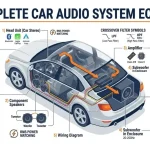
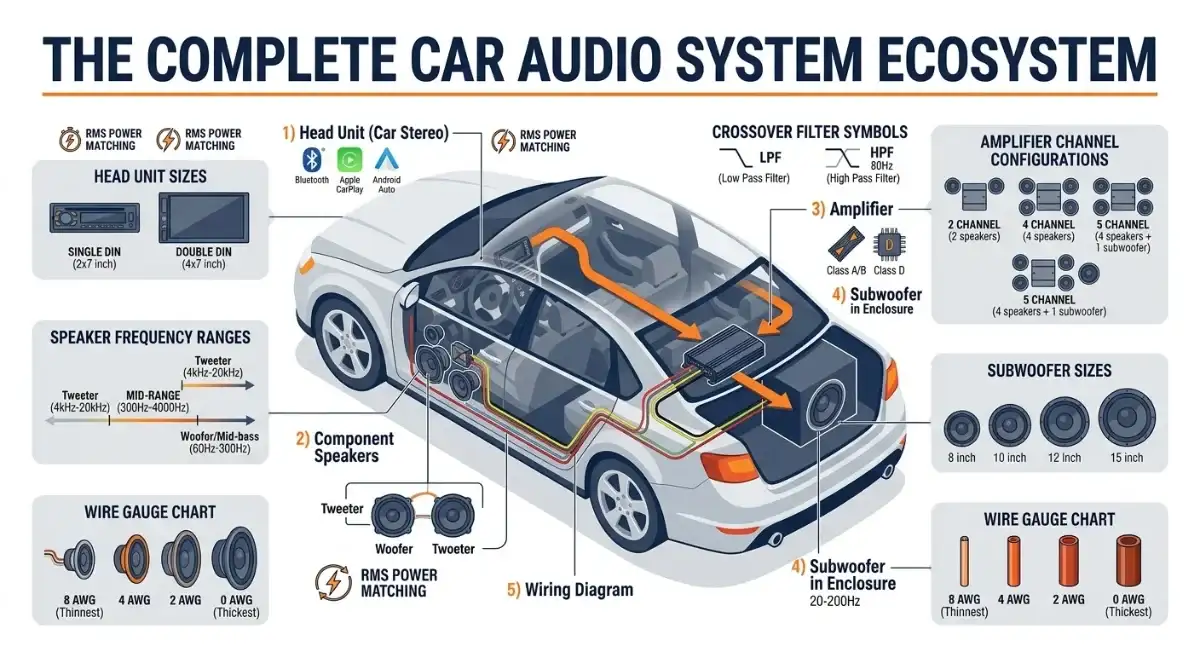
A modern car audio setup is an ecosystem. Each component, the head unit, speakers, amplifier, subwoofer, and wiring, plays a distinct role. Understanding how they work together is the first step toward building a system that sounds exactly the way you want it to.
Key Components of a Car Audio System
Every car audio system, whether stock or custom-built, relies on the same core building blocks:
- Head Unit (Car Stereo): The brain of the system, controls source, volume, and signal routing.
- Speakers: Convert electrical signals into sound you can hear.
- Amplifier: Boosts the audio signal to power speakers and subwoofers at high volume without distortion.
- Subwoofer: A dedicated speaker for deep bass frequencies (20–200 Hz).
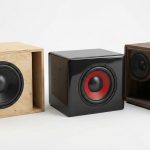
- Subwoofer Box/Enclosure: Houses the subwoofer and critically shapes its bass output.
- Wiring & Power Accessories: Connects everything safely and cleanly.
- Signal Processors / Equalizers: Fine-tune the sound to your taste and your car’s acoustics.
Head Units (Car Stereos)
The head unit is your control center. It sends an audio signal to your amplifiers and speakers, and determines what sources you can play, AM/FM radio, Bluetooth, Apple CarPlay, Android Auto, USB, or auxiliary input.
Single DIN vs. Double DIN
Head units come in two standard sizes:
- Single DIN: 2 inches tall, fits most older vehicles. Compact with basic controls.
- Double DIN: 4 inches tall, accommodates a touchscreen display. Best for modern multimedia features.
A Double DIN radio is now the most popular choice for upgrades because it supports large touchscreens, navigation, and smartphone integration.
What to Look for in a Head Unit
- Apple CarPlay / Android Auto support
- High preamp output voltage (4V or more for cleaner signal to amplifier)
- Built-in equalizer and time alignment
- Bluetooth audio streaming
- Sufficient USB ports and input options
Car Speakers
Speakers are the most audible upgrade you can make. Factory speakers use cheap paper cones and small magnets, they distort quickly and roll off high and low frequencies. Aftermarket speakers use stiffer cone materials (polypropylene, woven glass fiber, Kevlar), larger voice coils, and more powerful magnets.
Types of Car Speakers
Coaxial Speakers (Full-Range) Coaxial car speakers combine a woofer and tweeter into a single unit. They are a direct drop-in replacement for most factory speaker locations and offer a significant upgrade with minimal installation effort. Ideal for beginners or anyone on a budget.
Component Speakers Component systems separate the woofer, tweeter, and crossover into individual units. This allows for precise speaker placement, better imaging, and significantly improved soundstage. They are the choice of audiophiles and enthusiasts.
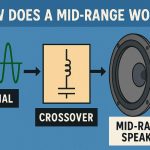
Mid-Range Drivers A mid-range driver handles the critical 300 Hz–4,000 Hz frequency voices and audio where most audio detail lives. Adding dedicated mid-range drivers to a three-way system produces a more natural, lifelike sound.
Speaker Sizes
Common car speaker sizes include 3.5″, 4″, 5.25″, 6″, 6.5″, 6×8″, and 6×9″. The 6×9 speaker is one of the most popular sizes because of its large cone area, which produces significantly more bass extension than smaller speakers.
Speaker Placement
Where a speaker sits in your vehicle affects its sound as much as its specs. Understanding how many speakers are in your car by default helps you plan which positions to upgrade first.
Parts of a Speaker
Every speaker shares the same core anatomy. Knowing the parts of a speaker, cone, surround, spider, voice coil, magnet, basket, and dust cap, helps you evaluate quality and understand what goes wrong when a speaker fails.
Car Amplifiers
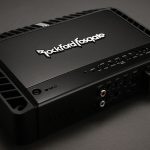
A car amplifier takes the low-level audio signal from your head unit and amplifies it into something powerful enough to drive speakers with authority. Even if your head unit has a built-in amplifier (as all of them do), an external amp dramatically improves headroom, reduces distortion at high volumes, and brings out detail in your audio.
Amplifier Classes
- Class A/B: The most common. Excellent sound quality, moderate efficiency. Best for door speakers and mid-range.
- Class D: Highly efficient (80–90%), runs cool. Dominant choice for subwoofer amplifiers.
- Class A: Audiophile-grade sound, very low efficiency. Rare in car audio.
How Many Channels Do You Need?
- 2-channel amp: Powers a pair of speakers or a single subwoofer in bridged mode.
- 4-channel amp: Powers front and rear speakers, or front speakers plus a subwoofer (bridged).
- 5-channel amp: Powers four speakers and a subwoofer from one unit, the all-in-one solution.
- Mono (1-channel) amp: Dedicated subwoofer power. Mono amps are almost always Class D.
LPF and HPF Crossover Settings
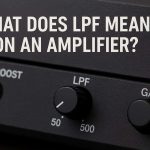
Every amplifier has built-in crossover filters. The LPF (Low Pass Filter) blocks high frequencies from reaching a subwoofer. The HPF (High Pass Filter) blocks low frequencies from overworking small speakers. Understanding what LPF means on an amplifier is essential for properly tuning your system so each driver only handles frequencies it was designed for.
Matching Amp Power to Subwoofers
A frequently asked question is what size amp you need for 2 12-inch subwoofers. The general rule is to match your amp’s RMS output to your subwoofers’ combined RMS power handling, usually 500–1,000 watts for a dual 12″ setup, depending on the subs’ impedance configuration.
Best Car Amplifiers
For a curated selection, see our guide to the best car amplifiers for every budget and setup style, covering everything from entry-level 4-channels to high-power mono blocks.
Subwoofers and Subwoofer Boxes
A subwoofer is a speaker built exclusively for low-frequency reproduction, typically 20 to 200 Hz. Your door speakers physically cannot move enough air to reproduce true bass at any real volume. A subwoofer solves this problem completely.
Choosing the Right Subwoofer Size
Subwoofer size affects bass extension, output, and the physical space required:
- 8″: Tight, punchy bass. Great for small enclosures and cars with limited trunk space.
- 10″: A balanced choice, decent extension with manageable size.
- 12″: The most popular size. Hits hard with excellent low-frequency extension.
- 15″: Maximum output and deep sub-bass. Requires a large box and a powerful amp.
Our detailed breakdown of best subwoofer size for deep bass will help you choose based on your audio preferences and vehicle constraints. For a side-by-side analysis, see our 12 vs 15 car subwoofers comparison.
If trunk space is limited, a hardest-hitting shallow mount subwoofer can deliver powerful bass from a slim profile enclosure.
Subwoofer Voice Coil Configuration
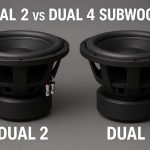
Subwoofers come in dual-voice-coil (DVC) configurations: Dual 2 Ohm and Dual 4 Ohm. The difference determines how you wire the sub to your amp and what final impedance the amp sees. Our Dual 2 vs Dual 4 subwoofer guide explains wiring options and how to choose the right configuration for your amplifier.
Subwoofer Enclosures
The box is just as important as the subwoofer itself. The wrong enclosure can cut your bass output in half, or double it.
Types of subwoofer enclosures:
- Sealed Box: Tight, accurate bass. Requires more power but delivers excellent transient response.
- Ported (Bass Reflex): Louder and more efficient at low frequencies. Larger box required.
- Bandpass: Very loud in a narrow frequency band. Less common for daily use.
- Free-Air: No enclosure, the subwoofer fires into the trunk. Requires a specific type of sub.
For full guidance on sizing, tuning, and selecting the right type, read our complete subwoofer box guide.
Best Subwoofers for Cars
See our tested roundup of the best subwoofers for cars to find the right model for your power level, audio preference, and budget.
Wiring and Power
Even the best components sound poor when connected with inadequate wiring. Power wiring, ground connections, and signal cables all have an enormous impact on sound quality and system reliability.
Power Wire Gauge
Use the right gauge for your amplifier’s current draw. As a general rule:
| Amplifier Power | Recommended Wire Gauge |
|---|---|
| Up to 500W | 8 AWG |
| 500W – 1,000W | 4 AWG |
| 1,000W – 1,500W | 2 AWG |
| 1,500W+ | 0 AWG |
Series vs. Parallel Speaker Wiring
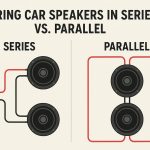
How you wire multiple speakers to one amplifier channel affects the total impedance the amp sees. Wiring speakers in series vs. parallel produces different impedances and affects power distribution. Series wiring raises impedance; parallel wiring lowers it. Most amplifiers prefer a 4-ohm load for full-range channels and 2-ohm or 1-ohm loads for mono/subwoofer channels.
The Big Three Upgrade
The “Big Three” refers to replacing three factory wiring connections with heavy-gauge wire:
- Battery positive to alternator
- Battery negative to chassis
- Engine block to chassis
This reduces electrical resistance throughout the vehicle, providing more stable voltage for your audio components.
Car Audio Capacitors
A car audio capacitor stores and releases electrical energy extremely quickly, much faster than a battery. When your amplifier demands sudden bursts of current during bass transients, the capacitor supplies that current instantly, preventing voltage sag that causes headlights to dim and audio to compress. A 1-farad capacitor is recommended for every 1,000 watts of amplifier power.
How to Tune and Optimize Your System
Installing quality components is only half the battle. Proper tuning is what separates a mediocre-sounding expensive system from a great-sounding affordable one.
Setting Gains
Amplifier gain does not control volume, it controls the input sensitivity. Set gain by matching your amp’s input level to the head unit’s output level to avoid clipping (distortion). Never set gain by ear; use a multimeter or oscilloscope, or use the “1kHz tone method.”
Crossover Settings
- Set HPF on full-range speakers to 80 Hz (24 dB/octave slope)
- Set LPF on subwoofer amplifier to 80 Hz (24 dB/octave slope)
- This creates a smooth handoff between speakers and subwoofer
Equalizer Tuning
A 5- or 31-band graphic equalizer, or a digital signal processor (DSP), allows you to compensate for your car’s unique acoustic challenges: road noise, speaker placement, glass reflections, and seat absorption.
For a practical, step-by-step approach to dialing in your system, read our guide to the best audio settings for car.
How to Get Louder Without an Amplifier
If you’re not yet ready for an amplifier, there are legitimate ways to improve your sound. Our guide on how to make car speakers louder without an amp covers 13 expert techniques, from deadening road noise to optimizing head unit EQ settings.
Bass Enhancement: The Epicenter
Compressed digital audio (Spotify, MP3, AAC) strips out sub-bass content. An epicenter is a bass restoration processor that analyzes your audio signal and synthetically recreates those lost low frequencies, giving your subwoofer more to work with.
Common Car Audio Problems and Fixes
Even well-installed systems develop issues over time. Here are the most frequent problems:
Alternator Whine: A high-pitched whine that changes with engine RPM. Usually caused by a bad ground or signal cable running near power cables. Fix with a noise filter or ground loop isolator.
Speaker Not Working on One Side: Can result from a blown fuse, incorrect balance settings, a damaged speaker, or a wiring fault. See our dedicated guide on car speaker not working on one side for a systematic diagnosis.
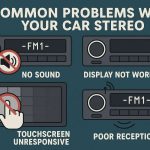
Head Unit Issues: Stereos can lose memory, fail to read media, or produce no sound. Many of these are fixable without replacement. Our guide to common car stereo problems walks through the most frequent failures and their solutions.
Distortion at High Volume: Almost always a gain setting issue. Re-set amplifier gains properly and ensure no clipping at the head unit output.
Subwoofer Not Hitting Hard: Check enclosure volume alignment, amp gain, LPF setting, and phase. An out-of-phase subwoofer will cancel bass instead of adding to it.
How Much Does a Car Audio Upgrade Cost?
Car audio upgrades span an enormous range. Here’s a realistic breakdown:
| Upgrade Level | Typical Cost (Parts + Install) |
|---|---|
| Entry-level (speakers only) | $150 – $400 |
| Mid-range (speakers + amp) | $400 – $900 |
| Full system (HU + speakers + amp + sub) | $900 – $2,500 |
| High-end / audiophile | $2,500 – $10,000+ |
For speaker-specific costs, our guide on how much it costs to replace car speakers breaks down labor, parts, and brand pricing in detail.
DIY vs. Professional Installation
DIY Installation is rewarding and saves labor costs (typically $75–$150/hour). It requires basic wiring knowledge, patience, and the right tools (wire strippers, crimpers, panel removal tools). Most head unit and speaker swaps are beginner-friendly.
Professional Installation is recommended for complex systems, especially when running power wire through the firewall for amplifiers, or when integrating with factory audio systems in modern vehicles with DSP or CANBUS signals.
If you go the DIY route, invest in quality wiring and connectors. Cheap connections cause more problems than cheap components.
Frequently Asked Questions (FAQs)
What is the most important component in a car audio system?
The speaker is arguably the most impactful single upgrade for most people, it’s the final step in the audio chain and the part your ears actually hear. However, the head unit is the starting point that defines signal quality, source options, and tuning capability. The best approach is to upgrade head unit first, then speakers, then add an amplifier and subwoofer for completeness.
Do I need an amplifier for car speakers?
All head units have a built-in amplifier, but factory and aftermarket head unit amps top out at around 15–22 watts RMS per channel. An external amplifier delivers significantly more clean power, 50–100+ watts RMS per channel, which translates to louder, clearer sound with better dynamics and less distortion at high volumes.
What is RMS power and why does it matter?
RMS (Root Mean Square) power is the continuous, sustained power a speaker or amplifier can handle or produce. Always match your amp’s RMS output to your speaker’s RMS rating, not peak power, which is a marketing figure that means very little in practice. Mismatching RMS ratings is the leading cause of blown speakers.
How do I reduce road noise in my car for better audio?
Acoustic deadening material applied to door panels, floors, and the trunk dramatically reduces road noise that competes with your audio. Brands like Dynamat, Noico, and Kilmat offer self-adhesive butyl rubber sheets that you cut and press onto bare metal surfaces.
Is a subwoofer necessary for good car audio?
Not for everyone, but yes, for most audio lovers. Human perception of bass is strongly tied to physical sensation, and door speakers simply cannot reproduce frequencies below 60–80 Hz at meaningful volume. A subwoofer takes the bass load off your full-range speakers, which then play louder and cleaner in their optimal frequency range.
Can I install a car audio system myself?
Yes, with the right tools and basic wiring knowledge. Speaker swaps and head unit installations are beginner-friendly projects. Amplifier installation (running power wire through the firewall, mounting, and tuning) is intermediate-level and requires more planning. Full system builds with multiple amps and custom fabrication are best left to or done alongside a professional.
What causes a car audio system to distort?
Distortion typically comes from clipping, either at the head unit (volume set above the “clean” level), at the amplifier (gain set too high), or from underpowering a speaker (causing the amp to clip trying to meet demand). Setting gains correctly and ensuring adequate power for all components eliminates the vast majority of distortion problems.
How long does a car audio installation take?
A simple speaker swap takes 1–2 hours per pair. A head unit installation takes 1–3 hours. A full system with amplifier, subwoofer, and wiring harness can take 4–8 hours depending on vehicle complexity and installer experience.