Picking an amplifier for a subwoofer isn’t about buying the biggest wattage number on the box. You need the amp’s RMS power at your sub’s final impedance to line up with the sub’s RMS rating. Get those two right and your sub plays loud, clean and safe.
Quick answer: Choose a mono (single-channel) amplifier whose RMS output, at the impedance your sub is wired to, is about 75–150% of the subwoofer’s total RMS rating. Example: a 400 W RMS sub wired to 2 Ω pairs well with an amp making roughly 300–600 W RMS at 2 Ω.
Step 1: Find Your Subwoofer’s RMS Rating
Look for RMS (continuous) power on the spec sheet, not “peak” or “max”. Peak power is a marketing number for brief bursts. RMS is what the voice coil can handle continuously. If you have two subs, add their RMS ratings together. Two 500 W RMS subs need about 1,000 W RMS in total.
Step 2: Work Out the Final Impedance
Amplifiers produce more power into lower impedance, so the same amp might make 300 W at 4 Ω and 500 W at 2 Ω. You need to know the final load the amp will see once everything is wired. That depends on whether your sub is single voice coil (SVC) or dual voice coil (DVC) and how you wire it:
| Setup | Wired in series | Wired in parallel |
|---|---|---|
| 1 × SVC 4 Ω | 4 Ω (single coil, no choice) | |
| 1 × DVC 4 Ω | 8 Ω | 2 Ω |
| 1 × DVC 2 Ω | 4 Ω | 1 Ω |
| 2 × SVC 4 Ω | 8 Ω | 2 Ω |
| 2 × DVC 4 Ω | Coils in series, subs in parallel: 4 Ω | Coils in parallel, subs in parallel: 1 Ω |
| 2 × DVC 2 Ω | Coils in series, subs in parallel: 2 Ω | All parallel: 0.5 Ω |
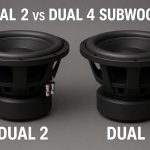
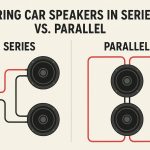
Never go below the minimum impedance your amplifier is rated for (“2 Ω stable”, “1 Ω stable”). Our series vs parallel wiring guide shows the wiring diagrams, and dual 2 vs dual 4 ohm subwoofers explains which coil option gives you better choices.
Step 3: Match the Amp’s RMS at That Impedance
Now look at the amplifier’s RMS rating at your final impedance and aim for roughly 75–150% of the sub’s total RMS. Near 100% is the sweet spot. The extra headroom up to about 150% is fine as long as the gain is set properly, because clean power is safer than a small amp driven into clipping.
| Your subwoofer setup | Total sub RMS | Look for an amp making… |
|---|---|---|
| One 8″, 200 W RMS, 4 Ω | 200 W | About 150–300 W RMS at 4 Ω |
| One 10″, 300 W RMS, DVC 4 Ω wired to 2 Ω | 300 W | About 225–450 W RMS at 2 Ω |
| One 12″, 500 W RMS, DVC 2 Ω wired to 1 Ω | 500 W | About 375–750 W RMS at 1 Ω |
| Two 12″, 500 W RMS each, DVC 4 Ω wired to 1 Ω | 1,000 W | About 750–1,500 W RMS at 1 Ω |
| Two 12″, 600 W RMS each, DVC 2 Ω wired to 2 Ω | 1,200 W | About 900–1,800 W RMS at 2 Ω |
Running two 12s? We cover that setup in detail in what size amp for 2 12s.
Underpowering vs Overpowering
- Underpowered: the sub sounds weak, so people crank the gain or bass boost. The amp clips, sending distorted square waves that overheat the voice coil. That’s how “small” amps blow subs.
- Overpowered: fine with a correctly set gain and a sensible low-pass filter. Problems start when the gain is maxed and the sub is pushed beyond its mechanical limits. Listen for flapping, popping or a burning smell.
Set the amp’s low-pass filter around 70–90 Hz to start (see what LPF means on an amplifier), turn bass boost off, and set gain with test tones or a multimeter rather than by ear at full volume.
Don’t Forget Your Electrical System
A bigger amp draws more current. Use the wire gauge your amp’s manual specifies for its fuse rating. Above roughly 1,000 W RMS, consider the “Big 3” wiring upgrade and a healthy battery. A car audio capacitor can smooth short peaks, but it doesn’t replace adequate wiring or charging capacity.
Want the math done for you? The free Car Audio Toolbox app includes calculators for wiring and system planning. Ready to shop? See our best car amplifiers.
Frequently Asked Questions
Can I use a 4-channel amp for a subwoofer?
Yes, if the amp supports bridging. Bridging two channels combines their power into one channel for the sub. Check the manual for the minimum bridged impedance, often 4 Ω. A dedicated mono amp is usually more efficient and stable at low impedance.
Is it OK if my amp is more powerful than my sub?
Yes, within reason (up to about 150% of the sub’s RMS) and with the gain set correctly. Clean headroom is safer than a small amp pushed into clipping.
What size amp do I need for a 1000 watt subwoofer?
First check whether “1000 watts” is peak or RMS. Most subs advertised at 1,000 W peak are rated around 250–500 W RMS, so match the amp to that RMS figure at your final impedance.
Does impedance change how much power I get?
Yes. Most car amps produce significantly more power at 2 Ω or 1 Ω than at 4 Ω. Always compare the amp’s rating at the impedance you’ll actually run.