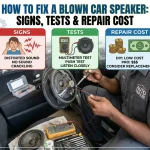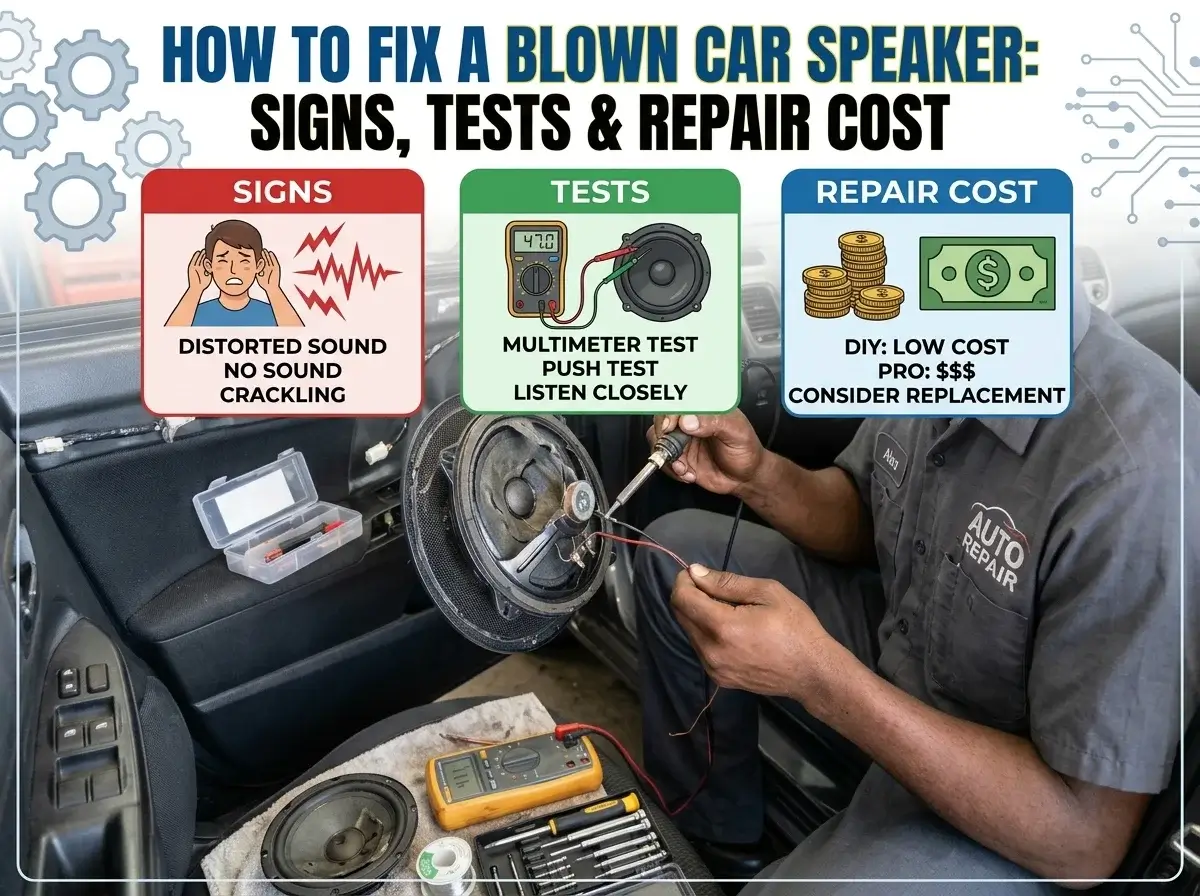
A blown car speaker usually shows up as crackling, rattling, a fuzzy “paper” sound, weak bass, or no sound at all from one door. The good news: not every blown speaker is dead. A torn cone, rotted foam surround, or a loose lead wire can often be fixed for under $20. A burnt or open voice coil is different. On a door speaker it almost always means replacement, and on a subwoofer it means a recone or a new sub.
Quick answer: Confirm the speaker is actually blown first (fader test + multimeter). Small tears and rotted surrounds are a cheap DIY fix ($5–$40). A burnt voice coil can’t be glued back. Replace door speakers (about $40–$250 a pair) or recone a subwoofer (around $130 for a 10″ at a repair shop).
Signs Your Car Speaker Is Blown
Speakers rarely fail silently. Listen for these symptoms, ideally with the same song at low and medium volume:
- Crackling, buzzing or rattling, even at low volume. A clean speaker only distorts when it’s pushed hard.
- Fuzzy, “paper” or scratchy tone on vocals. This often points to a voice coil rubbing the magnet gap.
- Weak or missing bass from one speaker compared with the other side.
- No sound at all from one location while the rest of the system plays.
- Visible damage: a torn or punctured cone, cracked or crumbling foam around the edge, or a cone that sits off-center.
Silence from one side isn’t always a blown speaker. A loose connector, a bad head-unit channel or the fader setting can cause the exact same symptom. If that’s your issue, run through our guide to a car speaker not working on one side before you buy anything.
How to Confirm a Speaker Is Actually Blown
1. Isolate it with balance and fader
Set the volume low and move the balance fully left, then right, then use the fader to switch between front and rear. If the noise or silence follows one physical speaker, that speaker (or its wiring) is the problem. If the distortion is on every speaker, look at the source, EQ settings or amplifier gain instead.
2. Do the gentle push test
With the stereo off, remove the grille and press the cone in slowly and evenly with your fingertips. It should move smoothly and silently. A scraping or grinding feel means the voice coil is rubbing or deformed, which is a coil failure, not a cone problem.
3. Measure resistance with a multimeter
Disconnect the speaker wires and set a multimeter to ohms (Ω). Touch the probes to the speaker’s two terminals:
| Reading | What it means |
|---|---|
| About 2.5–3.5 Ω on a 4 Ω speaker (or 1.5–2 Ω on a 2 Ω speaker) | Voice coil is intact, so look at the cone, surround, wiring or head unit |
| OL / infinite / no reading | Open (broken) voice coil or lead wire: speaker is blown |
| 0 Ω or very close to it | Shorted voice coil: speaker is blown and can damage your amp channel |
A healthy speaker reads a little below its rated impedance because the multimeter measures DC resistance, not impedance. Not sure what’s inside the speaker you’re testing? Our parts of a speaker guide explains the cone, surround, spider and voice coil.
What Can Be Fixed (and What Can’t)
| Problem | Fix | Typical DIY cost | Difficulty |
|---|---|---|---|
| Small tear or hole in a paper cone | Speaker-repair glue or rubber cement with a thin tissue patch | $5–$15 | Easy |
| Cracked or rotted foam surround | Refoam kit sized to the speaker | $15–$40 | Moderate |
| Lead (tinsel) wire broken or loose terminal | Re-solder the wire or replace the terminal | $0–$10 | Moderate |
| Burnt, open or shorted voice coil | Recone kit or professional recone (subs and high-end drivers) | Kit about 25% of a pro repair | Hard |
| Cracked basket or damaged magnet | Not repairable: replace the speaker | n/a | n/a |
For most factory and budget aftermarket door speakers, a burnt voice coil isn’t worth repairing: a new pair costs less than a recone. Reconing makes sense for expensive subwoofers and high-end component drivers. One specialist, ReconingSpeakers.com, gives about $130 as an example price to recone a 10″ speaker and notes that a DIY kit runs roughly a quarter of the professional price.
How to Fix a Blown Car Speaker: Step by Step
- Disconnect power. Turn the car off. For amplifier work, disconnect the negative battery terminal.
- Remove the trim panel. Use plastic trim tools to pop the door panel or grille clips without scratching. Unplug window and lock switches carefully.
- Unscrew and unplug the speaker. Take a photo of the wiring first so polarity (+/−) goes back the same way.
- Test it on the bench. Re-check resistance and inspect the cone, surround and lead wires in good light.
- Repair or replace. Patch small cone tears, refoam a rotted surround, or re-solder a broken lead. If the coil is open or shorted, fit a new speaker. Use an adapter bracket and wiring harness if the size or plug differs.
- Test before reassembly. Reconnect, play bass-heavy and vocal tracks at low and medium volume, and check balance/fader again.
- Refit the panel. Make sure every clip seats so the door doesn’t rattle.
Repair vs Replace: What It Costs
| Option | Typical cost | Best for |
|---|---|---|
| DIY cone or surround repair | $5–$40 | Torn cones, rotted foam on good-quality speakers |
| Professional recone | Around $130 for a 10″ (varies by driver) | Expensive subwoofers and high-end drivers |
| New aftermarket speaker pair | About $36–$240 for popular pairs | Most blown door speakers |
| Professional speaker installation | $99.99 at Best Buy (hardware not included) | If you don’t want to remove door panels |
Price sources: ConsumerAffairs (speaker pairs from about $36 for JVC to about $239 for Kenwood Excelon), Best Buy standard speaker installation ($99.99, about 75 minutes), and ReconingSpeakers.com for recone pricing. For a full breakdown by vehicle and speaker type, see how much it costs to replace car speakers.
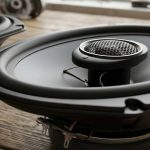
If you’re replacing rather than repairing, it’s a good moment to upgrade. Start with our picks for the best 6×9 speakers, or read up on coaxial car speakers if you’re replacing standard door speakers.
Why Car Speakers Blow (and How to Stop It Happening Again)
- Clipping. A distorted signal from a radio or amp turned up past its clean limit sends square waves that overheat the voice coil. That’s the most common cause of burnt coils.
- Amplifier gain set too high. Gain isn’t a volume knob. Set it to match the head unit’s output, not to make the system louder.
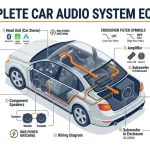
- Too much bass to small speakers. Door speakers asked to reproduce deep bass over-travel and tear surrounds. Use a high-pass filter around 80 Hz and let a subwoofer handle the low end.
- Bass boost and loudness at full volume. Stacked boosts push the signal into clipping fast.
- Age and heat. Foam surrounds dry out and crumble after years of sun and temperature swings.
Getting your crossover and EQ right prevents most failures. See our guides to the best audio settings for your car and what LPF means on an amplifier.
Frequently Asked Questions
Can a blown speaker fix itself?
No. A burnt voice coil, torn cone or broken lead wire won’t recover. If the sound comes back on its own, the cause was more likely a loose connection or an amplifier that went into protect mode.
Can a speaker be partially blown?
Yes. A partially blown speaker still plays but crackles, buzzes or sounds thin, usually because the voice coil is damaged or rubbing. It will typically get worse, so plan to replace it.
Can a blown speaker damage my stereo or amplifier?
A shorted voice coil (a reading near 0 Ω) can overload the head unit or amp channel driving it. Disconnect a speaker you suspect is shorted until it’s replaced.
How long does it take to replace a car speaker?
Usually 20–60 minutes per door for a direct-fit speaker, longer if the car needs adapter brackets or the door panel is complex. Best Buy estimates about 75 minutes for its standard speaker installation.
Is it worth repairing a blown car speaker?
Repair cheap problems such as tears, surrounds and loose leads. For a burnt voice coil, replace factory and budget door speakers. Recone only expensive subwoofers or high-end drivers.